Icon of the Picos de Europa
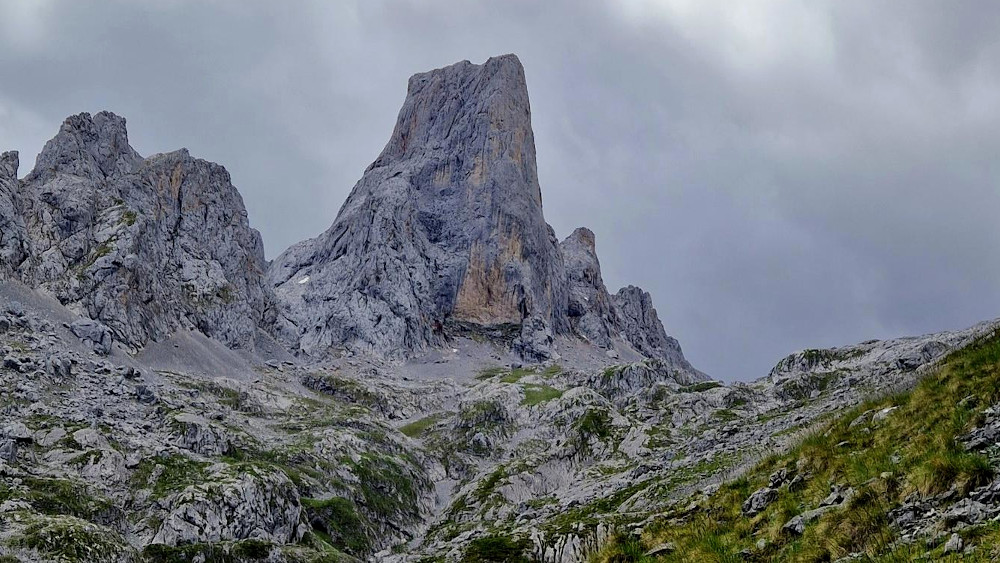
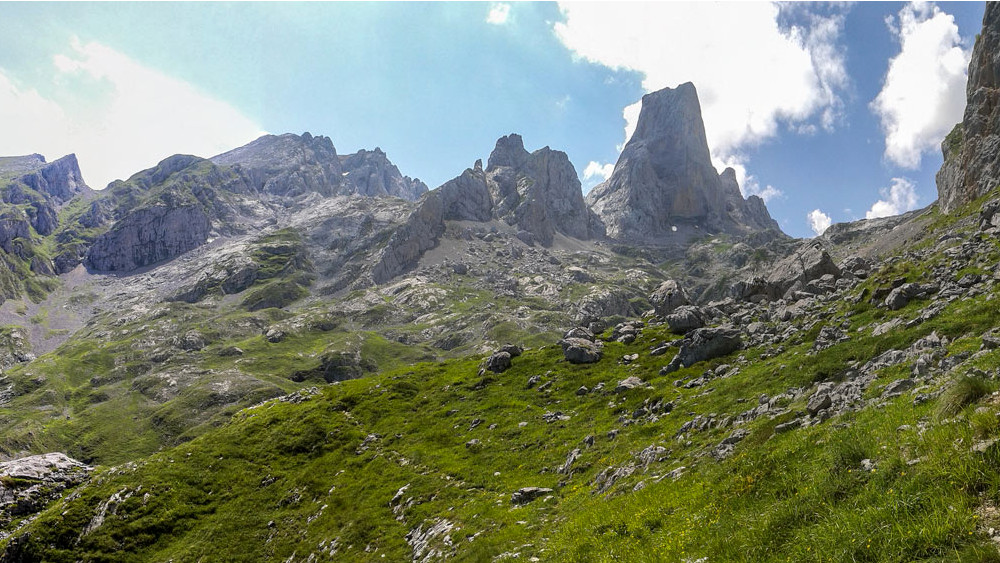
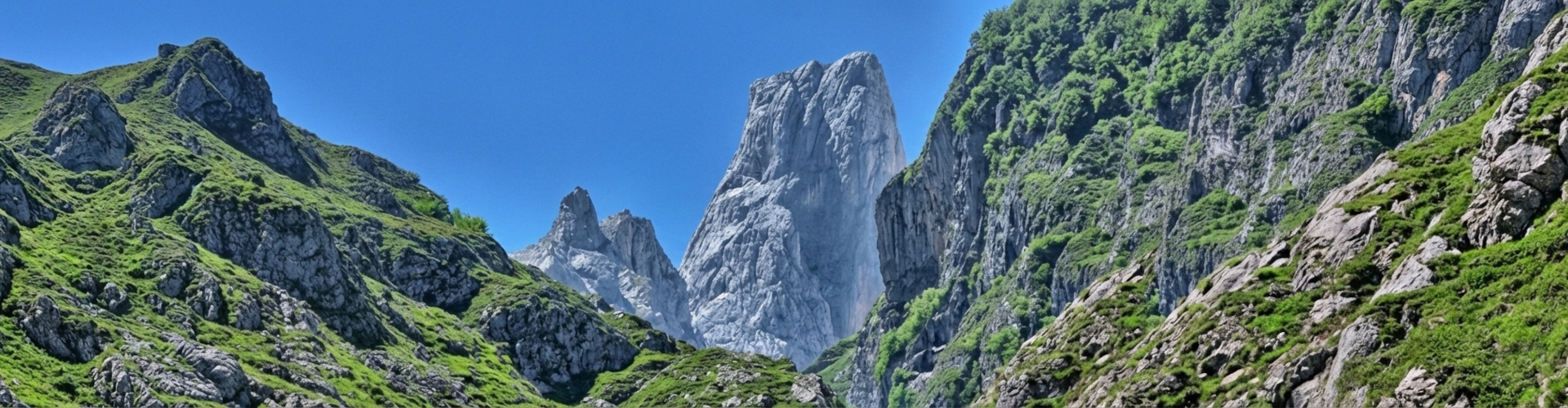
The Picu Urriellu, also known as Naranjo de Bulnes, is one of the most emblematic mountains of the Iberian Peninsula and one of the great symbols of mountaineering in Spain. With an altitude of 2,519 meters, it rises in the central massif of the Picos de Europa, within the council of Cabrales and the National Park.
Its unmistakable silhouette -an almost perfect limestone tower- rises above the Vega de Urriellu, a basin of glacial origin located at the foot of the mountain where the refuge of the same name is located. The isolated shape of the Picu and the verticality of its walls make it one of the most recognizable mountains in the entire Cantabrian range. Its four faces present great vertical walls, among which the west face stands out especially, an impressive wall of more than 500 meters of vertical drop that has turned the Urriellu into one of the great rock climbing scenarios in Europe.
Although it is not the highest summit of the massif -a distinction that corresponds to Torrecerredo (2.650 m)-, its singular shape, its history and its importance in the evolution of mountaineering have made it a reference mountain for generations of mountaineers.
The origins of mountaineering on the Urriellu
The modern history of the Picu Urriellu began on August 5, 1904, when Pedro Pidal y Bernaldo de Quirós and the shepherd of Cain Gregorio Pérez "El Cainejo" managed to reach its summit for the first time by the northeast face. That ascent marked one of the foundational milestones of mountaineering in Spain. Two years later, in 1906, the geologist and mountaineer Gustavo Schulze made the second ascent and used iron pegs during the descent down the south face, one of the first documented uses of this type of material in climbing in Spain.
From then on, the Urriellu began to attract climbers from different places, starting a long history of openings of new routes that, in time, would turn this mountain into one of the great climbing references of the peninsula.
The guides of Cabrales and the opening of new routes
During the first decades of the 20th century, the inhabitants of the nearby villages played a fundamental role in the history of the Urriellu. Among them, Víctor Martínez, a native of Bulnes, who in 1924 opened a new line on the south face that would bear his name. His sons, Alfonso and Juan Tomás Martínez, continued this legacy and in 1944 opened the well-known Directa de los Martínez, a variant that allows more direct access to the central terrace of the south face. Over time, this route became the most frequented itinerary on the mountain and allowed thousands of climbers to reach its summit.
Today, the Urriellu has dozens of climbing routes open on its different walls and remains an international reference for mountaineers and climbers.
The Vega de Urriellu refuge
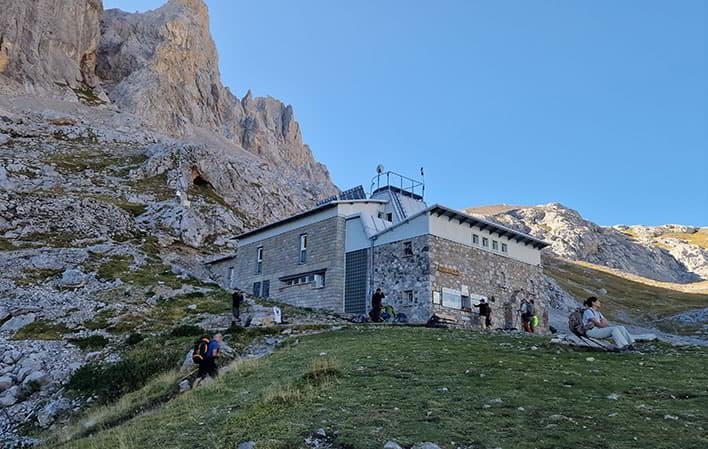
At the foot of the Picu is the Vega de Urriellu refuge, inaugurated in 1954 to coincide with the fiftieth anniversary of the first ascent. Its construction was an important boost for the development of mountaineering in the central massif of the Picos de Europa.
Today the refuge continues to be one of the reference points of the Cantabrian high mountains and a meeting place for those who approach this exceptional landscape.